
Tale Spin Gameplay
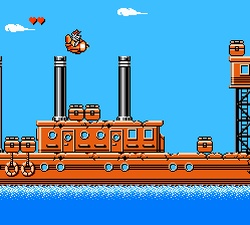
You grab the yoke and TaleSpin instantly locks into its groove: the engine purrs, a tight canyon yawns ahead, cash bags glint to the left, and pirate rounds twist through the air on the right. This isn’t just another side-scrolling shooter on the NES; it’s a proper seat in the Sea Duck, where every second is a tiny decision. Tap a button and the Sea Duck snaps on its axis, flipping 180 degrees in place. That snap-turn is TaleSpin’s signature move: cruising right, you catch a target off to the left in a split-second, hose it from the tail, then dive back into a safer lane. The ease of the gesture and that snug sense of control fuse with danger: one sloppy bank and you’re grinding rock, eating turret fire, or scraping a wing under a passing airship’s belly.
Route Rhythm
You don’t just fly forward; you chart the whole map. From the jump you pick where Baloo hauls the load: jungles, ice caves, dockside quarters, desert ruins. The level select feels like a mini captain’s brief—size up the risk, the payout, and what you’ll buy after the run. Every route has a personality. In the jungle you slalom through vines and stone gates; in the caves you thread stalactites and ride the counter-draft; in the city you wiggle between rooftops while flak guns bark. Vertical stretches change your breathing: one moment you surge upward through a fan of bullets, the next you sink into shafts where the air rings with metal and echo.
Cruising Economy
Money in TaleSpin isn’t just score. You snag sacks and gemstones, scoop cargo, and every coin hums with a plan: swing by the Higher for Hire hangar, where Rebecca is already tallying what’ll cover upgrades. The shop is the heartbeat between sorties. This is where Capcom’s Disney on NES hits different: not “just fly and shoot,” but fly smart so the route pays for itself. Upgrade the engine and the Sea Duck handles cleaner, peeling away from bursts. Grab a stronger cannon and boss duels shorten. Bolt on a cargo pod and the payload jumps—meaning on the next route you can spring for an extra life without flinching. Every purchase reshapes the flight, layering new habits onto the familiar run: sometimes it pays to linger and sweep everything, sometimes it’s better to disengage and keep your altitude.
Fire and Maneuver
The secret sauce is simple: guns and sticks don’t argue—they dance. There’s no mindless bullet hose here; there are patterns. Every pirate has a rhythm: one dives, another comes head-on and slips into scissors at the last moment. The on-the-spot flip keeps you from outrunning the screen: see an opening, turn on a dime, wipe the tail pack, slide back onto course. It nails that duel feeling: enemies sketch figures in the sky, and you thread their pattern, signing it with your own tracers. And yes, shooting backward isn’t optional—it’s essential. The tail is as much a battlefield as the nose.
Bosses and Their Quirks
Route finales throw you at distinctive machines and sky-pirate oddballs. A mechanical brute might surge up from the water; a lumbering battery hides behind a shield and starts playing angles. Reading their timing is half the win. At first it’s a wall of fire, but a couple of attempts in, you catch the breath: a safe dead zone on this side, a two-beat window over there, and a place to gamble with a point-blank pass. Just when you’re feeling like an ace, Don Karnage’s flagship looms on the horizon—your grip tightens on the pad. That duel is a focus exam: he feints, alters speed, shreds your muscle memory, and it feels so good to catch him with his own trick.
Pauses Between Storms
The game doesn’t keep you in a vice all the time. There are breaths of air. Bonus flights with Kit Cloudkicker are that warm “hooray” between scuffles. Kit pops up with his air board, and you flip from “survive” to “grab it all”: balloons, stars, that pleasant chime of points. No crusher traps here—just a soft breeze and the sense that the crew lives for more than routes and bullets.
Checkpoints spare you from a total reset, but they don’t let you coast: lose a life and you’ve lost a slice of the run. Continues exist, yet a couple of empty sorties make it clear the difficulty curve lives in your hands. Stingy in the shop? Expect some white-knuckle breaks. Generous? Enjoy a smoother cruise. That’s how TaleSpin—the very TaleSpin cartridge on NES—bottles its emotion: you chart your route, learn the level’s rhythm, bargain with bosses in their language, and roll back into the hangar with a new story every time. Next takeoff, you already know where to goose the throttle, where to hold for half a beat, and where to flick a wing and spin to snag that last money bag—the one that decides the whole run.